
The Future of Data Science: Why Technical Documentation Skills are the New Gold Mine
The world of Data Science is undergoing a massive transformation. For the past decade, the industry was obsessed with the “magicians”—the coders who could build complex algorithms and the mathematicians who understood the deepest layers of neural networks. But as we move further into 2026, the landscape has shifted. We have reached a point where the ability to write code is common, but the ability to explain that code is rare. Today, the real “gold mine” in tech isn’t just knowing how to build a model; it’s knowing how to document it so that a business can actually use it.
The gap between technical creation and business execution is widening. Companies are no longer impressed by a “black box” algorithm that produces results without an explanation. They need reproducibility, transparency, and clear communication. For students currently navigating this complex field, the pressure to master both coding and writing is immense. Many find that seeking Assignment help from experts like myassignmenthelp allows them to see high-quality examples of how technical reports should be structured, helping them bridge the gap between raw data and professional documentation.
Why the “Black Box” Era is Ending
In the early days of Big Data, data scientists were often left alone in a corner to work their magic. They would emerge weeks later with a prediction or a tool, and the company would take it on faith. However, this led to massive failures. Models were built that no one else could maintain. When the original developer left the company, the code became “legacy debt” because there was no documentation to explain how it worked.
Now, with the rise of MLOps (Machine Learning Operations), the focus has moved to the lifecycle of the project. A project is only as good as its documentation. If a teammate cannot look at your GitHub repository and understand your logic within ten minutes, the project is considered a failure. This is why technical documentation skills are becoming the highest-paid “soft skill” in the tech industry. It ensures that the work is sustainable, scalable, and secure.
The Role of Clear Communication in Data Mining
Data mining is one of the most technical aspects of the field, requiring a deep dive into unstructured data to find patterns. It is also one of the areas where students struggle the most to explain their methodology. If you are struggling with complex patterns, getting Data Mining Assignment Help can provide the clarity needed to document your findings effectively and ensure your academic projects meet industry standards.
Documentation as a Career Catalyst
If you look at the job descriptions for Senior Data Scientist or Lead Data Engineer roles in 2026, “communication” and “documentation” are listed right next to Python and SQL. Why? Because leaders need to justify their budgets to CEOs and stakeholders who don’t speak code.
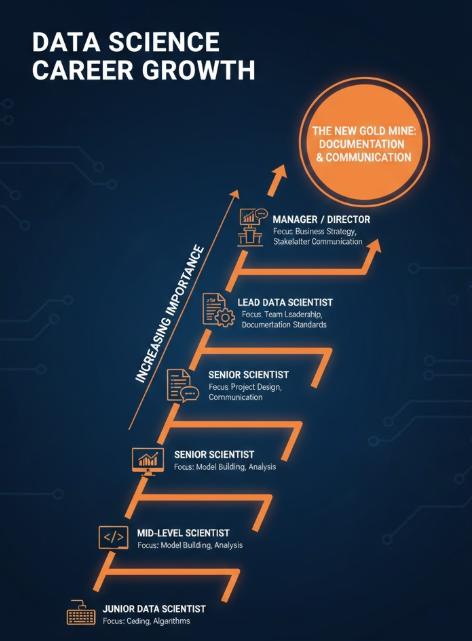
When you can translate a complex A/B test result into a clear, three-page technical brief that a marketing director can understand, you become indispensable. You are no longer just a “resource”; you are a bridge. This ability to translate technical jargon into business value is exactly what makes documentation a gold mine. It is the fastest way to move from a junior developer role into a management position.
Tools of the Trade: Markdown, Jupyter, and Beyond
Mastering documentation doesn’t mean writing long, boring essays. In the modern data science workflow, it means mastering specific tools that integrate with your code.
- Markdown: The universal language of documentation. Whether it’s a README.md on GitHub or a cell in a notebook, knowing how to format text clearly is essential.
- Jupyter Notebooks: These are the gold standard for “literate programming.” They allow you to combine live code, equations, and narrative text in one place.
- Docstrings: Writing clear explanations inside your Python functions so that others (and your future self) know exactly what the inputs and outputs are.
- Version Control (Git): Documentation isn’t just about the “what,” but also the “why.” Clear commit messages serve as a historical document of the project’s evolution.
The Student’s Challenge: Moving from Code to Content
For students, the transition from “getting the code to work” to “explaining why the code works” is the hardest hurdle. In a university setting, you are often graded on the accuracy of your output. But in the professional world, you are graded on the utility of your work.
Many students spend 90% of their time on the code and only 10% on the report. This is a mistake. A perfectly accurate model with a poorly written report will often receive a lower grade—and a lower salary—than a slightly less accurate model that is documented with precision and clarity. Learning how to structure a thesis or a dissertation in this field is about learning the art of the technical narrative.
Future-Proofing Your Career with “Human” Skills
As AI continues to write more of our base-level code, the value of the human “architect” increases. AI can generate a function, but it cannot yet understand the unique business context of a specific company or the ethical implications of a specific dataset.
The “Gold Mine” is the human element. It is the ability to look at a dataset, identify a problem, solve it with code, and then write a compelling document that convinces a company to take action. That final step—the writing—is where the real value is created.
Conclusion: Your Roadmap to Success
If you want to rank among the top 1% of data scientists, start treating your documentation with the same respect as your algorithms. Read technical blogs, study well-documented open-source projects, and never submit a piece of work that doesn’t have a clear, concise summary.
The future belongs to the “Full-Stack Communicator.” By focusing on your technical writing today, you are investing in a skill that will never be automated and will always be in high demand.
Frequently Asked Questions
Why is technical writing becoming so important in data roles?
As systems grow more complex, the ability to explain logic is essential for team collaboration. Clear records prevent “knowledge silos,” ensuring that a project remains functional and understandable even after the original developer moves on to other tasks.
What specific tools are used for project documentation?
Most professionals use a combination of Markdown for text files, Jupyter Notebooks for interactive data storytelling, and version control systems like Git. These tools allow you to integrate explanations directly alongside your code for seamless updates.
Can strong communication skills actually lead to higher salaries?
Yes. Technical expertise gets you the job, but communication skills get you promoted. Professionals who can translate complex data findings into actionable insights for stakeholders are often fast-tracked into leadership and management positions.
How does documentation affect the lifecycle of a machine learning model?
Proper documentation ensures reproducibility. It allows others to audit the data sources, understand the tuning of hyperparameters, and identify potential biases, which is critical for maintaining the long-term accuracy and ethical standards of the model.
About the Author
Min Seow is a Senior Academic Consultant at myassignmenthelp, where she specializes in bridging the gap between complex technical theory and professional communication. With years of experience in the education sector, she is passionate about helping the next generation of tech professionals master the essential skills needed to thrive in a rapidly evolving digital landscape.